


As I write this, I am working from a table overlooking my backyard instead of my office window to the parking garage next to the Hope and Healing Center (HHCI). I miss the daily interactions with my co-workers, but am grateful for the opportunity to continue my work on behalf of the Community Bioethics and Aging Center. I have also been reflecting on the whole business of “flattening the curve” for Covid-19 and considering the effect that this will have on all of us. There has been so much information (and yes, in some cases, misinformation) that I hope we will all take stock of the impact of this virus.
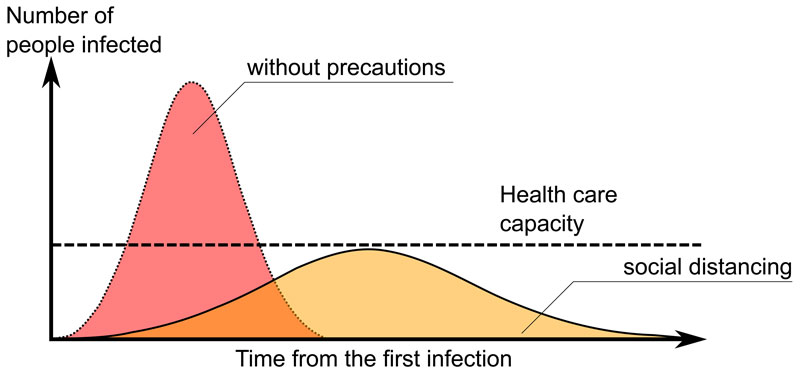
Why is it important to flatten the curve? Consider the rate at which people are hospitalized – we have seen the actual effect in Italy, a country the size of the state of Arizona. As of yesterday (March 18th), there are over 35,000 reported cases, with more than 4,200 new cases, which have yet to level off. At one large hospital in northern Italy, more than half of 1,000 hospital beds are devoted to Covid-19 patients. Even though Italy has 3.2 hospital beds per 1,000 patients (compared to 2.8 for the United States), the country is facing a shortage (NEJM, 3/18/2020). With overloaded hospitals, some treatments have been postponed until things calm down.
This is precisely the scenario that the US is trying to avoid by the “social distancing” actions that have been implemented around the country. In the worst case scenario, not only are hospital beds overloaded, but there is insufficient high-tech equipment to meet the need. As an example, patients with serious pneumonia having trouble breathing may need ventilators (breathing machines) until their lungs can recover. Ventilators are life-sustaining machines that can help people recover from serious illnesses, but there are a limited number of them in every hospital.
I have spoken and written frequently about the importance of patient autonomy, the ability for each person to decide their medical treatment for themselves, and justice, the equal treatment for all in medicine. However, when health care systems are overloaded, the individual’s choices become secondary to an ethic of helping the greatest number of people. Thus, difficult decisions may be needed to allocate the life-sustaining equipment (ventilators) to the individuals who would benefit the most. This is not a choice that most health care providers want to make – they want to be able to help everyone.
We already know that Covid-19 has a higher death rate with older individuals. This could be exacerbated if there are insufficient hospital rooms or ventilators to meet the need. I do not want to scare people, but as a chaplain who has sat with many doctors and families facing difficult treatment decisions, I know that no one wants to get the message that their loved one may not qualify for extended treatments because others are more likely to benefit.
The Centers for Disease Control, Veterans Administration, hospitals, and other institutions have all thought about these issues and prepared ethical guidelines. I have read some of them – they share the effort to help institutions to make good decisions, but they will not make us feel any better if the need to allocate resources affects our loved one.
So, if you are reading this, don’t panic. Stay close to home with your loved ones. Work from home if you have the option. Practice social distancing. Wash your hands. Clean your kitchen counters. Do all that you can to help to “flatten the curve” and we will all be better off. And pray – for those who are taking care of the sick, those who are testing new treatments and vaccines, and each other.
References
Rosenbaum, Lisa, “Facing Covid-19 in Italy — Ethics, Logistics, and Therapeutics on the Epidemic’s Front Line,” New England Journal of Medicine, March 18, 2020, https://www.nejm.org/doi/full/10.1056/NEJMp2005492, Accessed March 19, 2020.